Tuesday, April 2, 2013

Fountain Street Memorial to Reverend Paul Coffin


     Just up the street from my home is a memorial that has often intrigued me, but which I never investigated. I visited the memorial in late March, early in the morning during my commute. The memorial is a fountain dedicated to the memory of Reverend Paul Coffin, D.D. and his grandson Cyrus Woodman. It sits at the corner of Fountain Street (naturally) and Route 4A in Bar Mills, just a couple of hundred feet from the Saco River. The fountain has never flowed in the 18 years I've known of it, which makes me a little sad. Behind the fountain is a small open field with a tiny pond, suggestive of a common green space. Nobody hangs out there except mushrooms, frogs, and frog-hunting cats.


     The first item that caught my eye was the name of the grandson, Cyrus Woodman. Just up the road off of Salmon Falls Road is Woodman Road, no doubt named for him or his family. I also knew there was a Paul Coffin house right around the corner, so I began digging up information on Reverend Coffin.


Coffin house, Buxton, 1888

     Reverend Paul Coffin, D.D., was a Harvard College educated minister who served Buxton from 1761-1821, the dates on the fountain memorial. Buxton was known as Narraganset No. 1 then, and the Province of Maine was still part of Massachusetts. He was the first minister in the town, and as was typical of the time, he was paid by the town proprietors to settle here. He was ordained in the town in 1763, the year the French and Indian War ended, and was a moderate Calvinist at a time when Anglicanism was growing in Maine and threatening Congregationalists. The house pictured above was built for him in 1763, the year he was married. The top pictures show the house today, and the bottom one shows the house in 1888.


     Reverend Coffin lived through some very interesting times, from the problems with the Great Proprietors, through the last of the Indian wars, through the Revolutionary War and finally seeing Maine become a state. His arrival in Narraganset No. 1 was to a frontier town, but things quickly changed with the influx of migration after the end of the Indian wars. He also saw Massachusetts outlaw slavery in 1783 and the nascent beginnings of the Second Great Awakening.

     The memorial fountain was designed by a famous Portland architect, John Calvin Stevens, and was donated in 1894. Other than being Buxton's first minister, Reverend Coffin is credited with naming Buxton when it was incorporated in 1772. Nobody knows why the name was chosen, but we know he couldn't use his wife's maiden name, Gorham, since that was already in use.

     Other reasons for memorializing him may have been because of his other connections in town. His daughter, Dorcas, married Dr. Royal Brewster, who built the Brewster Mansion across the street from where the reverend preached. The house is one of four buildings in Buxton listed in the National Register of Historic places.

     He served his town a long time, conducting over 1,000 sermons and officiating at nearly 500 weddings. His original church no longer stands, for the Tory Hill Meeting House was built in 1822 on the site of his old log church. He didn't live to see it open.

     The second person memorialized was his grandson, and he was quite accomplished as a lawyer, lumberer and land speculator. He helped publish a history of Narraganset No. 1 and the Great Proprietors, several well known maps, his grandfather's sermons, and a genealogy of his family. He left money to Bowdoin College, his alma mater, and donated land to become a park at Pleasant Point. Although he lived much of his life in Wisconsin, he came home to Buxton and is buried in the town. As his memorial says, he was "Constant in love for his native town".

This memorial says very little, but with a little effort one can see that this family had a huge impact on a new town on the edges of frontier Maine.


Sources consulted included:
http://www.buxtonhollishistorical.org/images/buxton_bhhs_page_tour.pdf
http://www.mainememory.net/artifact/23389
http://www.mainememory.net/artifact/11456
http://www.mainememory.net/artifact/11694/zoom
http://www.wisconsinhistory.org/dictionary/index.asp?action=view&term_id=2565&keyword=Genealogy

Eastern Cemetery


      My second site visit was to Eastern Cemetery, another stop on the Portland Freedom Trail. I visited on a week night in late March, and unfortunately the cemetery was closed and locked, even though I had arrived an hour and a half before sunset. I walked the perimeter fence and was struck by the trash, broken headstones and fallen trees. This cemetery, for all of its historical significance, needs some tending. Nobody was checking it out except me and my friend Jay. I took photos and vowed to come back another time so I could wander the headstones and see for myself just who lived here, so to speak.

     Eastern Cemetery is located at 224 Congress Street at the base of Munjoy Hill and is listed on the National Register of Historic Places. It is the oldest large cemetery in Portland, established in 1668, soon after much of southern Maine was annexed by Massachusetts Bay Colony but before the Province of Maine officially became part of the Massachusetts Bay colony in 1691 - and before Falmouth was renamed Portland. The cemetery is very close to the waterfront and was located in a mixed neighborhood of immigrants, including Jews, African Americans and Irish. I discovered this was also a stop on the Maine Irish Heritage Trail, for many early Irish Catholics are buried here, though many of the graves are lost.

    The cemetery is about 5 acres in size, though it began as a smaller plot adjacent to a common green. It contains remains of those who fought in the Revolutionary War and the War of 1812. There is a monument to the first Portland soldier killed in the Civil War, Alonzo Stinson (pictured below), but most burials ended in the cemetery before the Civil War; some sources suggest the cemetery was closed in the 1860's with scattered burials shortly thereafter. In addition to war veterans (the captains of the HMS Boxer and USS Enterprise who fought off Monhegan in the War of 1812 are buried side by side), many people who were influential in Portland's civic life are buried here, including not a few abolitionists (the cemetery is not far from the Abyssinian Meeting House), congressmen, and artists. Some of the first English settlers in Falmouth are buried here, too, though the early grave sites can no longer be identified.


     Although it was no longer in regular use at the time, the cemetery was pictured prominently in a painting dated circa 1866 of the Great Fire of Portland from Eastern Cemetery, 1866 by George Frederick Morse, a Portland artist. I found this interesting, having learned about the fire in association with the saving of the Abyssinian Meeting House nearby.

   
 The cemetery is significant because it is a physical and ancestral link to Maine's very early colonial history up through the mid-19th century. It reminds us that the people of Portland have been participants in major events in American history and have left their mark on the social, political and physical landscape of Maine and the United States.
     The cemetery is cared for by a group called Spirits Alive which conducts historical tours July through October for a small fee, all of which go to maintaining the cemetery. The mostly volunteer group also holds events and lectures, with the aim of keeping the cemetery open, accessible and well maintained while educating the public about its history and its inhabitants. 


Sources consulted include:
http://www.spiritsalive.org/
http://www.ci.portland.me.us/publicworks/historiccemeteriesinfomation.asp
www.mainememory.net
National Register of Historic Places


Sunday, March 31, 2013

The Abyssinian Meeting House

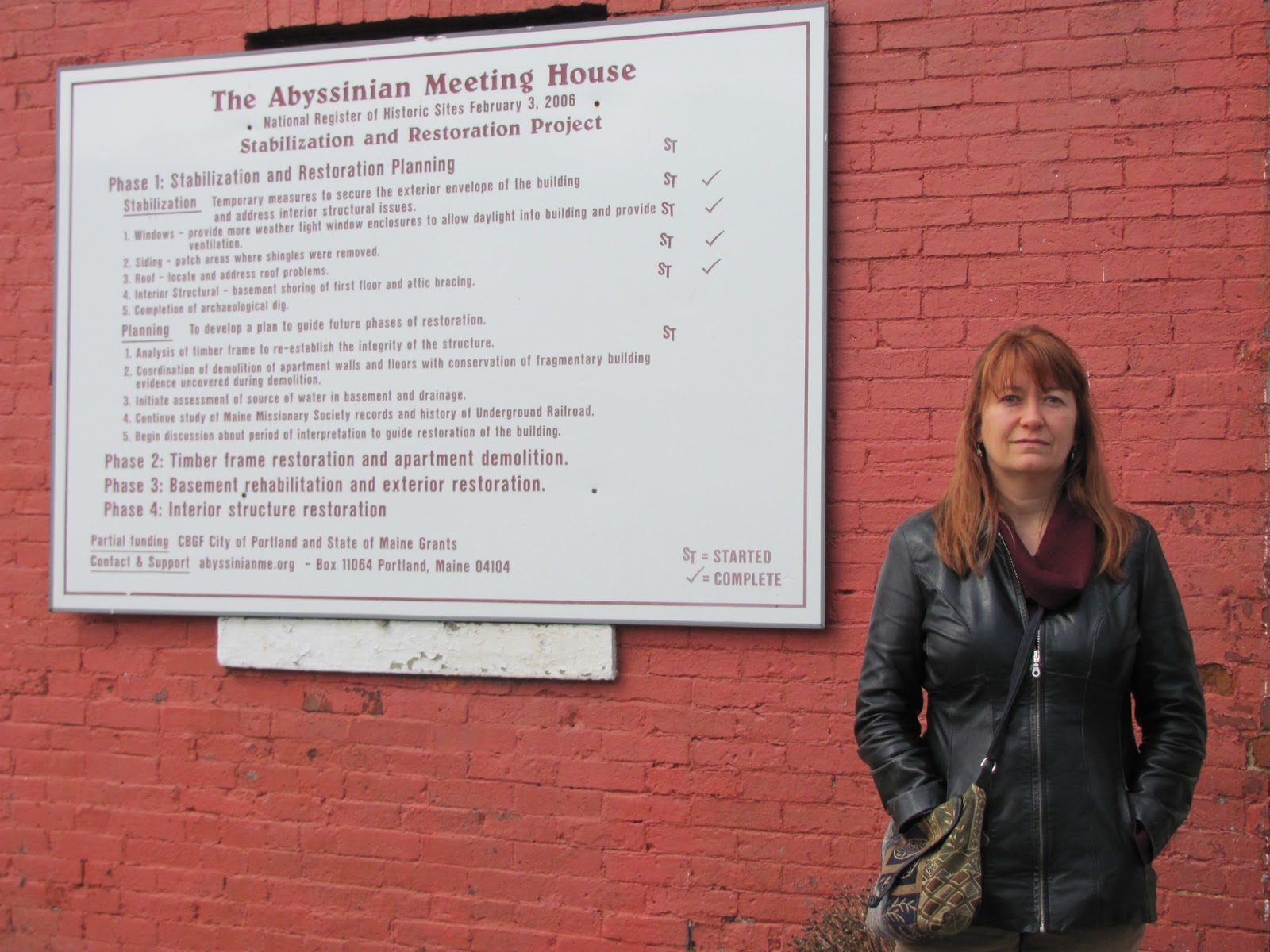
     My first historical site visit was to the Abyssinian Meeting House in Portland, Maine, located at 73-75 Newbury Street. The early March day was chilly, and it took a while to find the site, which is tucked into an urban neighborhood of one way streets and multifamily apartment buildings. Surprisingly, two other people stopped by to check out the building; whether they were curious to see what my husband and I were gawking at, or they just happened by at the same time, I couldn't tell. Still, it was nice to see others taking an interest in it.


     The Abyssinian Meeting House was not open. It is currently undergoing a total restoration by The Committee to Restore the Abyssinian Meeting House, so we had to content ourselves with reading the information on the building and reading the plaque in the sidewalk (after getting down and blowing off a winter's worth of road sand from it!). The Department of the Interior entered the building into the National Register of Historic Places in 2006.


     The meeting house is part of the Portland Freedom Trail, which marks sixteen sites in Portland associated with people, places or events connected to the Underground Railroad and the abolitionist movement. The Abyssinian, according to the plaque, had the distinction of being the first black church in Maine. It opened in 1828 and is the third oldest black church still standing in the U.S. The meeting house was mostly financed by African American Reuben Ruby, who waited tables and then opened his own hack stand (horse drawn taxi stand) in Portland. Other blacks helped finance the building, which was erected by free blacks. The original impetus for building was to have a place for black people to worship where they weren't treated as second class citizens (they were relegated to the worst parts of churches, the uppermost levels and the very back).
     The Abyssinian Congregational Church was the heart of the African American community in Portland, and served many purposes. Opening in 1828 in the middle of the second Great Awakening (1790-1860), it was a hot spot for meetings and discussions of reform issues of the day, including temperance, education and abolition. It was a church, a place for Bible classes, sewing circles, a school and was a stop on the Underground Railroad. It drew important and influential abolitionist speakers, including William Lloyd Garrison and Frederick Douglass, who educated and challenged the public to fight for the rights of blacks. Runaway slaves also spoke there about their first hand experiences, due partly to the efforts of the Reverend Amos Freeman, the Abyssinian's first full time minister and an Underground Railroad agent. Other ministers over the years at the Abyssinian were also outspoken abolitionists.
     The proximity of the Abyssinian to Portland's docks also made it easier for escaped slaves to make their way there, with the help of many of Portland's free blacks. Blacks held positions that were of low visibility (dock workers, mariners, hack drivers, etc.), but which had strong social connections that enabled them to move people along the route to freedom.
     One of the Abyssinian's distinctions was that it survived the devastating Portland fire of 1866, which destroyed more than 1,500 buildings. Because of the quick thinking and efforts of William Ruby, a firefighter and Reuben Ruby's son, the building continued to serve the black community until it closed and was sold in 1917.
     After undergoing significant structural changes, including being made into a tenement apartment building, the meeting house was purchased for historic preservation in 1998. The building had a long, important history in Portland and a large role in helping many escaped slaves make it to freedom in Canada and overseas. The restoration will help educate the public about Portland's black cultural, social, educational and religious history, and about the Abyssinian's larger role in the social reform movements in American history.


Sources consulted for information included:
http://www.abyme.com/
http://www.portlandfreedomtrail.org/
Excerpts from Maine's Visible Black History on Blackboard
http://en.wikipedia.org/wiki/Abyssinian_Meeting_House
Class notes from HTY 360, History of Maine